
I Built Shredder: An Algo Framework for a Market That Won't Sit Still
March 27, 2026
Shredder
I did not set out to find the holy grail of Bitcoin entries.
I set out to build a place where my own strategies could live: defined in code (or sketched with math and, cautiously, AI), tested against history, stressed in simulation, and run in paper mode long before any real money is at risk. That place is Shredder—a monorepo with a NestJS API, a Next.js dashboard, tick workers per symbol, backtests, and a risk layer that says “no” more often than my optimism does.
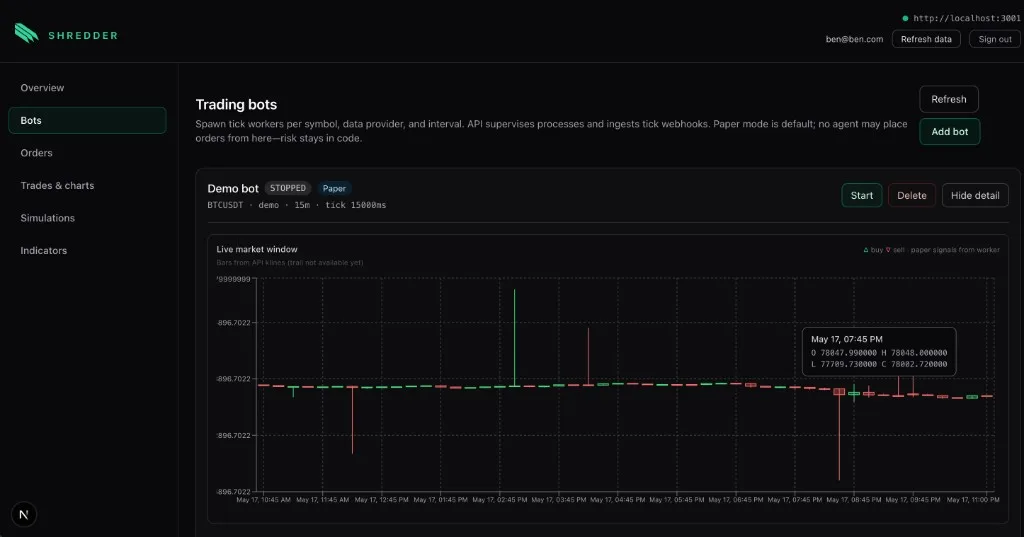
The dashboard looks serious. Green candles, buy/sell markers, a bot on BTCUSDT with a 15m interval and a 15s tick. What it does not show is certainty. Under the hood, Shredder is an argument that modeling markets is brutally hard and that a perfect algo is a category error—not a delayed engineering task.
What Shredder is
Shredder is a framework, not a signal-selling machine:
| Piece | Role |
|---|---|
apps/api | Supervises bots, ingests tick webhooks, auth, orders queue (BullMQ + Redis) |
apps/worker | Pulls candles, runs registered strategies, evaluates risk, emits paper or live intent |
apps/dashboard | Bots, simulations, indicators, charts—no agent may place orders from the UI |
packages/strategies | Your logic, registered like plugins |
packages/backtest | Historical runs with fees and simulation metrics |
packages/risk | Hard limits on drawdown, notional, equity floor |
packages/ai | Suggest-only tooling—not autonomous trading |
You spawn a tick worker per bot (symbol, data provider, interval). The API watches the process and receives webhooks on each tick. Paper trading is the default; flipping to live intent requires explicit env and exchange keys—and even then, the README is blunt that parts of the order path are still demo placeholders, not production exchange plumbing.
That honesty is the point. I would rather ship a lab than a lottery ticket with a logo.
Why markets resist a “perfect” model
A perfect algorithm would need a perfect model of the market. Markets are not a closed system with stable rules. They are other people, liquidity, regulation, narrative, and feedback loops—all changing the rules while you play.
1. The world is non-stationary
Backtests assume the past is a rehearsal for the future. It rarely is. Volatility clusters, correlations flip, and regimes change (calm grind, liquidation cascade, range-bound chop). A strategy tuned on 2023 data can be charity in 2025. You are not fitting one distribution; you are fitting a distribution that moves.
2. You only see what survived
Survivorship bias is not a footnote. Delisted coins, blown-up funds, and strategies that stopped being marketed do not appear in your CSV. What remains looks more predictable than the full population ever was.
3. Overfitting is the default outcome
Given enough indicators and parameters, you will find a curve that explains history and confuses the future. Walk-forward tests, out-of-sample holds, and simple strategies help—but they do not grant immunity. The market has more degrees of freedom than your validation split.
4. Execution is part of the strategy
Backtests love mid-price fills. Reality has spread, slippage, partial fills, latency, and fees. Shredder’s backtest path includes fee modeling and simulation metrics for a reason: a signal that wins on paper can lose on taker fees alone. Your 15m candle does not care that your order arrived 200ms late.
5. The map is not the territory
OHLCV bars compress microstructure: who lifted the offer, how thin the book was, whether your size moved the price. A candlestick is a cartoon. Strategies drawn on cartoons can be witty and still wrong.
6. The market fights back (reflexivity)
If an edge is real and scalable, capital piles in until it shrinks. Published patterns get arbed. Your bot is not trading in a vacuum; it is trading in a crowd that includes other bots—and your own past trades can change liquidity. There is no fixed “true” price process to discover once and encode forever.
7. Tail risk is not optional
Models trained on benign samples underestimate gap risk, exchange outages, stablecoin stress, and plain weirdness. A drawdown cap in code (Shredder’s risk engine blocks buys when equity breaches floors or drawdown limits) is necessary; it is not sufficient. Black swans are not outliers in the economic sense—they are outliers in your dataset.
8. AI does not repeal any of this
Shredder can call an LLM for suggestions (POST /ai/suggest). That is useful for exploring indicator combinations or narrating a backtest—not for outsourcing judgment. Language models interpolate text; they do not hold a joint distribution over tomorrow’s order book. Paste a shiny “AI analyst” on a bad strategy and you get confident losses.
What “good” looks like instead
If perfection is off the table, what remains is process:
- Hypothesis in code — Strategies are versioned, reviewable functions—not vibes in a spreadsheet.
- Backtest with skepticism — Include fees, stress parameters, and simulation ledgers; treat great Sharpe ratios as guilty until proven robust.
- Paper first, always — Workers default to paper mode; the dashboard labels Paper loudly. Live keys and mainnet are opt-in, testnet by default when you wire Binance.
- Risk outside the strategy — Strategies propose
BUY/SELL/HOLD;DefaultRiskEnginecan veto buys on drawdown, notional caps, and equity floors. Risk stays in code, not in a chat prompt. - Separation of concerns — The UI supervises and visualizes; it does not trade. No “click here to let GPT size your position.”
The screenshot above is a demo bot on paper: candle trail, paper buy/sell markers, worker output in the trail API. It is a laboratory window—not a track record.
Architecture in one breath
When you hit Start, the API spawns a Node worker with env for symbol, interval, webhook URL, and bot id. Each tick: fetch or synthesize candles, run strategies, aggregate signals, run risk, optionally record a paper trade event, POST JSON back to the API. The dashboard polls trails and renders a candlestick chart with overlays.
Rust shows up in the repo for performance-sensitive pieces; TypeScript carries most of the product surface. Postgres holds users, bots, and history; Redis queues orders. It is boring infrastructure on purpose—excitement belongs in research, not in surprise production behavior.
The impossibility of the perfect algo
“Perfect” would mean: for all future states relevant to your capital, your rule always maximizes risk-adjusted return subject to your constraints. That requires omniscience or a stationary generative model that the world does not provide.
Even in academia, the efficient-market intuition pushes back: persistent, scalable, low-risk alpha is rare because smart people hunt it. In practice, you are always trading model risk (your assumptions are wrong), implementation risk (bugs, outages), and incentive risk (you will override the system after three red days).
So Shredder does not promise alpha. It promises structure:
- A place to test ideas.
- Defaults that assume you will be wrong.
- Guardrails that fail closed.
- A path from simulation → paper → (if you ever choose it) live—with eyes open.
Try it yourself
Clone the repo, bring up Postgres and Redis with Docker, copy .env.example to apps/api/.env, run migrations, then:
pnpm install
pnpm --filter @shredder/db db:deploy
pnpm --filter @shredder/api dev
Run the dashboard separately, register a user, create a paper bot, watch ticks arrive. Read the README for Binance testnet keys, strategy registration, and security notes.
If you want a calmer relationship with markets—track what you own without betting on prophecy—see my other project Elliott, a portfolio tracker that stays on your device. Shredder is the opposite energy: hypotheses and falsification, not net-worth comfort food.
Closing thought
The market is not a puzzle with a missing piece. It is an adversarial, non-stationary, partially observed system where your edge decays and your mistakes are billed in dollars.
Building Shredder taught me that the win is not finding the perfect algo. The win is building a discipline that survives knowing you never will—and still finding the work fascinating.
Code and docs: github.com/maggiben/shredder. Trade at your own risk; this is not financial advice.