
Pour Over as Meditation: Four Minutes With James Hoffmann (and a Scale That Judges You)
May 19, 2026
Pour over · V60 · Ceremony
I make pour-over coffee once, maybe twice a day. Not because I am precious about beans (okay, a little), and not because instant coffee committed a crime against humanity in a past life (debatable). I do it because the ceremony forces me to slow down.
For four-ish minutes the world shrinks to: hot water, wet paper, the smell of fresh grounds, and a scale that displays my life choices in grams. That window is my meditation—breathe in the aroma, watch the bloom rise like a tiny brown soufflé, and mentally line up whatever chaos the day plans to throw at me. By the time the drawdown finishes, I am calmer. Caffeinated, yes. But calmer.
I did not always brew this way. For years my holy grail was the perfect espresso—and I bet everything on a bean-to-cup machine to get me there. That machine is the reason I pour over now. The full story matters, because the V60 only makes sense once you’ve heard what the button machine couldn’t do.
My bean-to-cup journey (and why I walked away)
I bought into the dream hard: fresh beans go in, the machine grinds, tamps, pulls, and out comes something that looks like the café menu photos. I adjusted strength sliders. I played with bean origins. I ran cleaning cycles like religion—descaling, rinsing the brew unit, emptying drip trays, chasing clogs, wiping grinds out of corners that should not exist. I told myself that if I just dialed in one more variable, I’d nail that shot.
Watch the bean-to-cup in action
This is the machine I used every day—grinding, tamping, pulling—until I swapped it for a V60.
The problem wasn’t that it failed loudly. It failed almost well enough to keep you hooked. Some mornings the espresso was passable. Some afternoons it was thin and sour. I could never quite trust it—and trust is everything when coffee is supposed to be the calm before the storm of your day.
These machines don’t make the coffee I thought they would
I’m not saying all bean-to-cup machines are scams. I’m saying mine—and others in the same class—have limits that marketing glosses over:
The built-in grinder throws fines everywhere. Along with usable particles you get a cloud of dusty fines. They over-extract and leave the cup muddy and bitter no matter how “medium” you think the setting is. You can’t see the grind bed. You can’t sweep fines out. You’re locked into whatever particle chaos lives inside the housing.
Temperature is a moving target. Real espresso wants stability around 93 °C. Home bean-to-cup boxes lean on thermoblocks and shortcuts: heat, cool slightly, push water through, hope. The result is irregular extraction—sometimes sharp, sometimes flat, rarely the same twice in a row.
Maintenance is a part-time job. “Automatic” does not mean “hands-off.” Descaling cycles smell like vinegar confessionals. The brew group needs thorough cleaning or oils turn rancid. Grinder channels cake up. Drip trays overflow when you forget them once. The machine demands care; it just doesn’t reward you with a cup that justifies the labor.
And the taste? It never got there. Not undrinkable. Not good in the way a careful pour-over is good—bright, clean, intentional. I was chasing perfect espresso and landing in the land of “fine, I guess.” That gap wore me down more than any single bad shot.
| What I chased | What the bean-to-cup delivered |
|---|---|
| Café-quality espresso at home | Inconsistent shots—good day, meh day, why-is-it-sour day |
| “It grinds for you” convenience | A grinder I couldn’t tune, spewing fines I couldn’t fix |
| Reliable extraction | Irregular temperature and mystery hydraulics inside plastic |
| Low daily effort | Thorough maintenance either way—just hidden behind a touchscreen |
| A morning ritual | One button—beans in, beverage out, brain still on standby |
The deal-breaker wasn’t taste alone—it was the missing ceremony
I could have lived with “pretty good” coffee if the process had grounded me. It didn’t. There is no ritual in a button. You don’t rinse paper and smell the bloom. You don’t stand at the counter breathing in fresh grounds while water spirals over the bed. You don’t watch four minutes tick by on a scale and feel your shoulders drop. You press start, listen to the grinder scream, and wait for a beep like it’s a microwave.
That’s not meditation. That’s vending.
What I wanted—and what I have now with pour-over—was the opposite: take my time, control the variables, and make the cup I actually want, not the cup an algorithm guesses I want. Grind on a burr mill I chose. Water from a kettle I trust. Bloom, pour, drawdown—each step a small gate I walk through on purpose. The smell of fresh coffee hits before the first sip. By then I’ve already started breathing, slowing down, and preparing mentally for whatever challenges the day has queued up.
The bean-to-cup went quiet. The V60 took its place on the counter. No drama—just clarity: I’d rather spend four minutes in a ceremony than four seconds pretending one.
Everything below is that ceremony—the pour-over life, with a nod to James Hoffmann for the technique that finally made the cup match the intention.
Why ceremony beats "just hit brew"
The technique I follow is basically James Hoffmann's gospel, filtered through a home kitchen and a yellow bag that says desde el mat (from the farm, more or less—my Spanish is fueled by coffee, not Duolingo). Hoffmann is the world's most convincing man in an apron: precise without being preachy, nerdy without being unbearable. If you want the source sermons, search his channel for the Ultimate V60 technique and the one-cup pour-over guides. What follows is my lived ritual, with his numbers as the spine.
Pod machines, bean-to-cup boxes, drive-throughs, and the "I'll chug whatever is hot" school of survival all have their place. Pour-over is different. It is deliberately inefficient in the best way:
| Fast coffee | Pour-over ceremony |
|---|---|
| Button → cup | Kettle → scale → patience |
| Background noise | Foreground ritual |
| Fuel | Preparation |
The slowness is the feature. You cannot doom-scroll effectively while pouring in concentric circles—well, you can, but you will overshoot 250 g and Hoffmann's ghost will sigh audibly. The ritual asks for attention: grind size, water temp, pour height, timing. That attention is what clears my head.
Twice a day is enough. Morning: armor up for meetings and code reviews. Mid-afternoon (optional second round): reset before the final boss level of the day. More than that and I'd vibrate through the floorboards.
The cast of characters
You do not need a lab. You need consistency:
- V60 dripper (plastic, ceramic, or glass—glass looks heroic in photos)
- Paper filters sized for your dripper
- Gooseneck kettle (temperature-controlled if you are feeling fancy; otherwise boil and wait ~30 seconds)
- Digital scale with a timer (non-negotiable; this is your coach)
- Fresh coffee, whole bean, roasted within weeks not geological eras
- Grinder (burr > blade; blade grinders produce "random particle size distribution" which is engineer for "sadness")
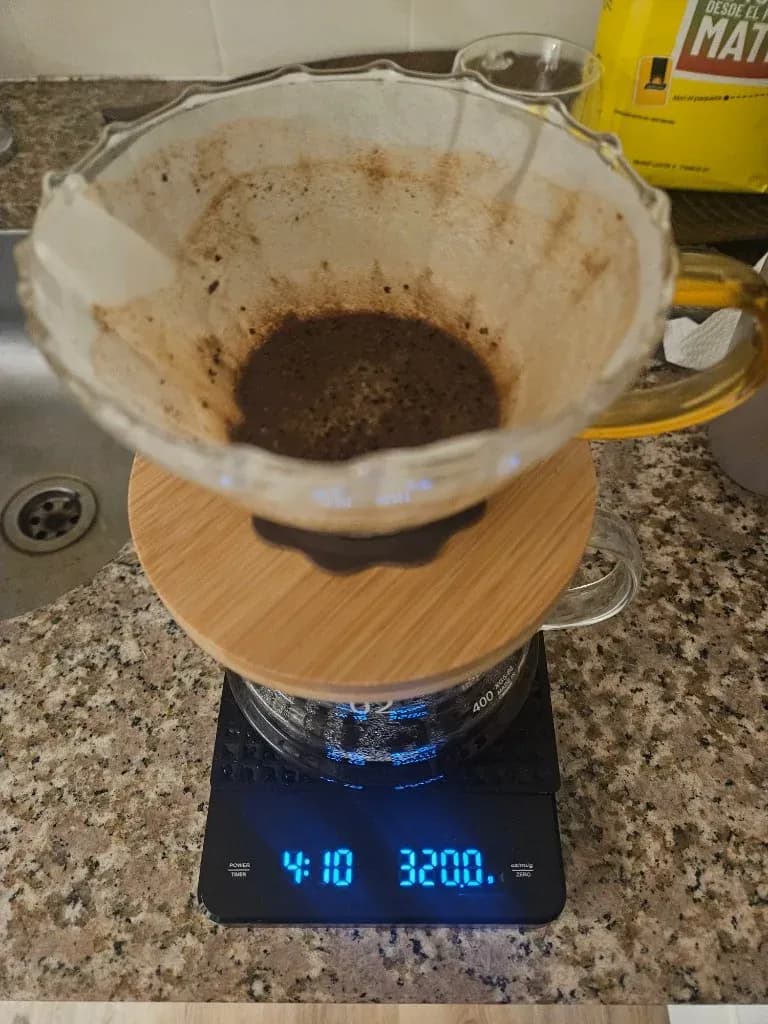
My setup in the photo: V60 on a wooden stand, server underneath, scale reading 4:10 and 320 g—because I was mid-drawdown and apparently living dangerously on total yield. Hoffmann's classic ratio is closer to 15 g coffee → 250 g water; I sometimes stretch for a larger mug. The scale does not judge. Much.
How to choose coffee and grind
Beans: Buy from a roaster you trust, or a bag with a roast date—not just "best before the heat death of the universe." Lighter roasts = more acidity and fruit; darker = chocolate and bitterness. For V60, light to medium is the playground Hoffmann loves.
Grind: Aim for medium-fine—like coarse sand, not powder, not gravel. Too fine → bitter, slow drawdown, existential dread. Too coarse → sour, watery, "why did I get out of bed."
If you own a burr grinder, rejoice. If you buy pre-ground, buy small bags and use them fast; ground coffee goes stale faster than your New Year's resolutions.
Ratio starting point: 1:16 (15 g coffee, 250 g water). Adjust to taste once you can repeat the ritual without flooding the kitchen.
The ceremony, step by step
This is the Hoffmann-shaped workflow I actually use. Total time: about 3½–4½ minutes after the kettle is ready.
1. Heat water
Bring water to a boil, then let it sit 30–60 seconds off boil. Target roughly 95 °C / 203 °F. Boiling water directly on delicate grounds can scorch; lukewarm water makes tea cosplay.
2. Weigh and grind
Weigh 15 g of beans. Grind fresh. Inhale. This is the first meditation hit—the smell of fresh coffee is unfairly good. Breathe it in. Your nervous system already thinks the day might be okay.
3. Rinse the paper (do not skip)
Place the filter in the V60. Rinse with hot water—at least a cup's worth. This:
- Washes away paper taste (yes, it is real)
- Preheats the dripper and your mug/server
- Reminds you that you are doing ritual, not rush
Dump the rinse water. Put the V60 on the server/mug on the scale. Tare to zero.
4. Add grounds and make a well
Add the 15 g of grounds. Level the bed. Optional: a small divot in the center so water does not stage a coup on the first pour.
5. Bloom (the fun part)
Start the scale timer. Pour 50 g of water over the grounds (roughly 3× the coffee weight). Give the dripper a gentle swirl so all grounds get wet. Wait 45 seconds.
Watch the bloom puff up. This is CO₂ escaping and chemistry doing poetry. Breathe. You are not "making coffee"; you are transitioning state.
6. The main pour
Pour steadily until you reach 250 g total on the scale. Hoffmann's style uses a controlled spiral from center outward, keeping the bed even—not blasting one spot like a fire hose of regret.
Let it draw down. Stop pouring when you hit target weight; let gravity finish the extraction. Total brew time often lands around 3:00–3:30 on the timer by the end—your mileage varies with grind and altitude and whether Mercury is in retrograde.
7. Serve and exist
Remove the V60. Swirl the server if you are fancy. Pour into a warmed mug. Do not gulp. You earned four minutes; take thirty seconds to actually taste it.
What Hoffmann taught me that no machine did
A few lines I keep from his school of thought:
- Weigh everything. Volume lies; grams tell the truth.
- Rinse the filter. Every time. You are not too busy for paper-flavor insurance.
- Bloom is not decoration. It sets extraction up for success.
- Grind and water temp matter as much as origin story on the bag.
- Repeatability beats heroics—a boring good cup every day beats a lottery cup once a month.
He also convinced me that coffee is one of the few daily crafts where amateur equipment still produces world-class results if you respect the variables. You do not need a $3,000 espresso machine to have a moment of quiet excellence. You need a kettle, a V60, and the willingness to stand still.
My twice-a-day mental prep
Morning brew: Before Slack, before email, before the todo list metastasizes. The ritual says: you control the first minutes of the day. Grind, rinse, bloom, pour—each step a tiny gate you choose to walk through slowly.
Optional afternoon brew: When the brain is porridge. Same steps, shorter internal monologue. The smell alone reboots focus; the pause prevents reactive clicking.
Neither session is about perfectionism. Some cups are brighter, some murkier. The win is showing up to the process—breathing, smelling, pouring, waiting—so the challenges ahead meet someone who already practiced patience at the kitchen counter.
Troubleshooting without drama
| Symptom | Likely cause | Fix |
|---|---|---|
| Bitter, harsh | Too fine / too hot / too slow | Coarser grind, slightly cooler water, pour gentler |
| Sour, weak | Too coarse / under-extracted | Finer grind, ensure full bloom, check total time |
| Drawdown forever | Grind too fine or clogged filter | Coarser grind, avoid stirring mud |
| Tastes like paper | Skipped rinse | Rinse the filter. Apologize to Hoffmann. |
Go forth and pour slowly
If you have never tried pour-over, start with Hoffmann's Ultimate V60 Technique video and one bag of beans you actually like. Accept that the first week is practice. Accept that the scale is your friend. Accept that four minutes of ceremony might do more for your head than four minutes of scrolling.
Me? I'll be at the counter once or twice a day—timer ticking, steam rising, bloom swelling—getting ready for whatever comes next. One gram at a time.