
Math Before Apps: A Vintage Calculator Collection on One Table
May 19, 2026
Calculators
There is a particular smell to old electronics: warm plastic, faint ozone from a display that hasn't slept in forty years, and the quiet arrogance of a device that thinks 2 + 2 is the most important problem in the universe.
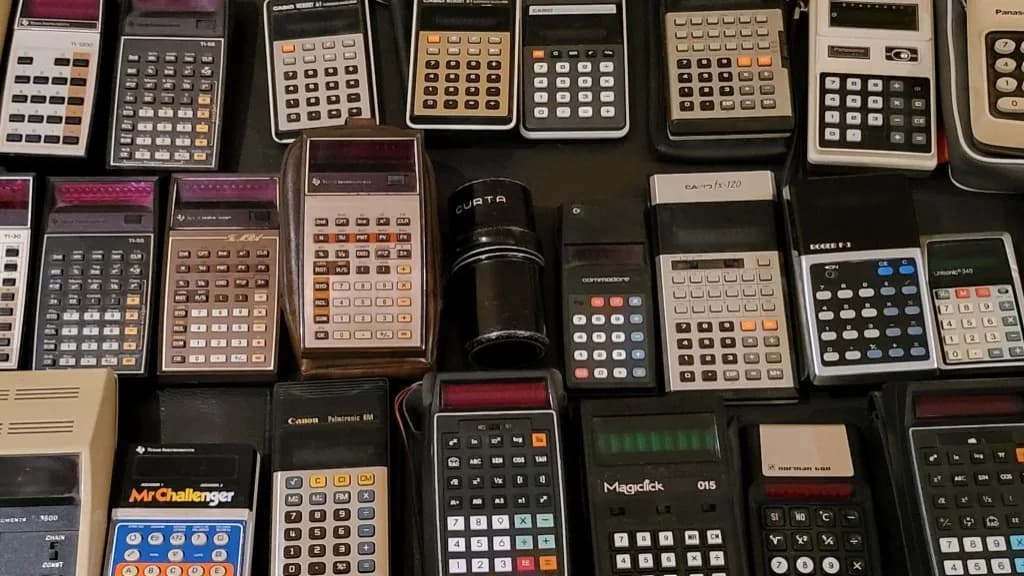
This table is my answer to that smell. Roughly thirty calculators—mechanical, LED, VFD, early LCD—laid out like a timeline you can pick up with both hands. No app store. No subscription. Just buttons, digits, and the story of how humanity outsourced arithmetic to things that fit in a shirt pocket.
The pepper grinder that could do calculus (sort of)
Dead center sits the outlier: a Curta.
Black, cylindrical, covered in little sliders and a crank on top. Nicknamed the math grenade or pepper grinder, it is the last great mechanical calculator—a masterpiece of gears and levers invented by Curt Herzstark in a Nazi concentration camp, refined after the war, and sold until the early 1970s. No batteries. No display. You crank and the digits advance with a satisfying mechanical certainty that silicon still hasn't quite replicated.
Everything else on this table is electronic. The Curta is the ancestor they all politely nod to before glowing green.
When numbers learned to glow red
The Texas Instruments cluster in this photo is basically a museum of the LED era (roughly 1972–1978):
| Model (in the collection) | Why it matters |
|---|---|
| TI-1200 | Cheap, cheerful, four-function—calculators for everyone, not just engineers |
| TI-55 | Scientific pocket power; red digits that drank batteries like espresso |
| TI-58 / TI-59 | Programmable beasts; the 59 in its leather case is the crown jewel—magnetic cards, serious keys, "I have homework and a personality" energy |
| Mr. Challenger | TI's playful side: a children's math toy dressed as a calculator, because the 70s believed learning should beep |
TI didn't just sell calculators—they collapsed prices and triggered the Calculator Wars of the mid-70s: pocket devices went from hundreds of dollars to under $20 in a few years. Engineers cheered. Slide-rule companies filed for emotional damages.
Red LED displays were gorgeous and terrible: bright in the dark, nearly invisible in sunlight, and always hungry for AA batteries. You learned to cup your hand over the display like you were telling a secret.
The green glow: Casio, Canon, and the VFD dynasty
Pan to the Casio and Canon units and the palette shifts from red to electric green.
That's the vacuum fluorescent display (VFD)—a tiny neon-ish tube behind digits that look like they belong on a spaceship console. Casio leaned into it hard: models like the fx-120 and Memory A-1 feel like they were designed by someone who watched 2001 once and decided banking should feel futuristic.
The Canon Palmtronic 8M with its cheerful blue, yellow, and white keys is peak "we put a computer in your pocket, please don't drop it." Magiclick 015 leans into the same vibe—big green readout, chunky keys, the aesthetic that said portable before portable meant thinner than your wallet.
VFDs burned less power than LEDs and looked cooler. They also broke hearts when LCDs arrived and didn't need to glow at all.
Everyone else in the pile
A collection this dense is a brand map of the 70s:
- Commodore — yes, that Commodore, before the C64: sober black case, colorful function keys, proof that everyone wanted a piece of the pocket-math gold rush
- Panasonic — white, chunky, reliable in the way consumer electronics pretended to be eternal
- Unisonic 940 — one of a thousand respectable also-rans in an industry exploding faster than anyone could trademark a name
- Rockwell — aerospace pedigree, calculator division; because if you can land on the Moon, you can surely sell a four-function box
Each one is a slightly different bet on the same question: How many keys can we fit before the human thumb files a complaint?
Three displays, one revolution
If you squint at the photo, you're watching display technology race itself:
Mechanical digits (Curta)
        ↓
Red LED — power-hungry, romantic, doomed
        ↓
Green VFD — brighter, cooler, still a little thirsty
        ↓
Gray LCD — boring, victorious, still here
The Curta computes with metal. The TI-55 lights up red filaments. The Casio line glows green plasma. Later slim models in the pile whisper with liquid crystal—no halo in a dark room, but batteries that last long enough to forget where you put them.
That progression isn't trivia. It's the same arc as watches, radios, and laptops: visibility vs efficiency, until efficiency wins and we miss the glow.
Why collect these at all?
Phones do math better, faster, and with spell-check.
But a phone doesn't have tactile guilt when you press = wrong. It doesn't have a leather case that smells like someone's engineering school years. It won't sit on a shelf and silently argue that 1974 was a peak aesthetic year.
I collect these because they're finished objects—designed, manufactured, sold, and abandoned on a known schedule. No firmware update will add a subscription. No cloud will delete your memories of compound interest. The TI-59 doesn't ping you at 2 a.m. asking for a rating.
They're also humble. Every one of them solved the same ancient human problem—I don't want to do this arithmetic in my head—with whatever chips and displays the decade could afford. The Curta did it with precision machining. The TI-59 did it with a program store. The TI-1200 did it with optimism and six AAA cells.
If you're starting a shelf of your own
You don't need thirty. You need three eras:
- One mechanical or early electronic oddity — Curta if you're brave; any 60s desktop is a lesson in scale
- One red LED scientific — TI-50-something territory; buy spare batteries
- One green VFD Casio or Canon — turn off the lights, accept the grin
Check for battery corrosion before you fall in love. Respect the key feel—some membranes are dead and can't be resurrected with nostalgia. And read the model number: the Calculator Wars produced a hundred variants with names that sound like droids.
Conclusion
This table isn't really about arithmetic. It's about a twenty-year window when computation left the desk, visited the pocket, and learned to glow.
The Curta cranks. The TI-59 waits in its case like a briefcase from the future. The Casios still look like they could dock with a station. And somewhere in the pile, a Mr. Challenger is still daring a child to beat it at multiplication.
We live in the age of apps now. But for a while, math had buttons—and some of us still like pressing them.