
The Threat Globe: Watching Cyber Attacks Cross a WebGL Planet
May 24, 2026
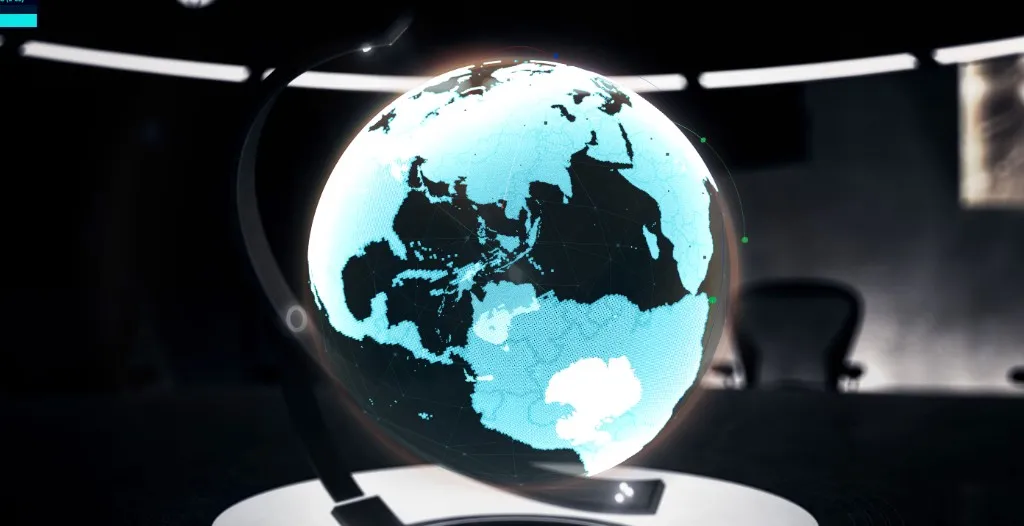
Threat Globe · Globex
At a cybersecurity firm years ago, we had the cliché that is also the truth: a big screen with a spinning Earth and colored lines showing hostile traffic. It was not cinema—it was how analysts felt scale. Your SIEM might say “47,000 events,” but a arc from Eastern Europe to a sensor in Virginia makes the same fact spatial. You stop counting rows and start seeing geography.
I never forgot that wall. Recently I rebuilt it as Globex—a full-screen 3D threat globe in the browser, live at threat-globe.vercel.app. Land masses are a TopoJSON point cloud; great-circle arcs animate from real blocklisted IPs toward fixed “sensor” cities. Drag to orbit. Right-drag to pan. The planet slowly rotates whether or not anyone is watching—which is exactly the point.
See it live
Click inside the embed once so orbit controls capture the pointer. Demo arcs start immediately; the live pool swaps in after the server finishes geolocation (often 10–20 seconds on first load).
Blank embed or WebGL blocked? Open the threat globe in a new tab.
Tiling still works if you ever span multiple displays—same query params as the older globex experiments:
https://threat-globe.vercel.app/?fullWidth=1920&fullHeight=1080&x=0&y=0
What you are actually looking at
The visualization is honest about its limits—and I think that matters more than pretending we tapped a backbone.
| Layer | Source | What it means |
|---|---|---|
| Globe geometry | world-atlas 50m TopoJSON → ~150k land points on a sphere | Geography you can orbit, not a flat Mercator poster |
| Arc sources | Open blocklists: Feodo Tracker, Emerging Threats compromised IPs, FireHOL level1 | Known-bad IPv4 addresses, batch-geolocated via ip-api.com |
| Arc destinations | Hard-coded SENSOR_TARGETS in the API handler | Chosen for visual spread, not because we own those honeypots |
So each arc is not a live packet capture between two real endpoints. It shows: this IP was recently seen on abuse feeds → draw a plausible great-circle path toward a representative sensor city. That is the right tradeoff for a free, zero-auth demo you can open in a tab. For production SOC walls you plug in your honeypot, GreyNoise, OTX, or TAXII feed and keep the same { sources, targets } response shape.
Under the hood:
Main.jsmountsGlobeon the stage.Maps.jsrasterizes land and borders into aTHREE.Pointscloud.AttackFeed.jspollsGET /api/attacks?mode=poolevery ~90s and spawns arcs (~4/sec, max 50 active).attacks-handler.js(Vite dev middleware + Vercel serverless) builds and caches the geolocated pool.
Console tells the story: Attack pool: demo arcs (starting) until live pool loads → Attack pool loaded: N sources (feodo:…, …).
Why real-time attack maps still matter
Cybersecurity has become ambient noise for everyone who is not paid to read logs. Headlines mention “ransomware,” “state-sponsored,” or “zero-day,” but the felt risk stays abstract. A globe does one thing spreadsheets cannot: it turns abuse data into motion and place.
For the general public
You do not need to understand STIX or Suricata rules to grasp “machines in country A are probing sensors in country B, continuously.” That picture supports healthier habits: patch your router, turn on MFA, treat weird emails as normal weather rather than personal drama. It also counters security theater—if the map is quiet while your inbox is not, you learn that visibility is partial. No consumer globe replaces endpoint protection; it teaches humility about what you can see.
For government agencies
Nation-state activity is discussed in geopolitical terms, but defenders live in flows: scanners, botnets, credential stuffing, DDoS reflectors. Shared blocklists and community feeds are imperfect—biased toward what gets reported, blind to encrypted channels—but they are still early weather. Agencies use similar views for situational awareness, coordination with ISPs, and public communication when an incident has a clear geographic signature. The policy lesson is dual: invest in sensor networks and responsible sharing, and do not confuse a pretty arc with attribution (IPs lie, proxies abound).
For companies
Inside a SOC, the wall map is a shared heartbeat. Junior analysts notice spikes; executives stopping by for a demo absorb that attacks are ongoing, not quarterly projects. The business takeaway is operational: defense is a stream, not a ticket closed in Q3. Maps pair well with runbooks—when Feodo-sourced arcs cluster, someone checks email gateways; when FireHOL lights up, firewall teams validate egress rules. The globe is the ambient monitor; the work is still in logs, EDR, and identity.
| Audience | What the map gives | What it does not replace |
|---|---|---|
| Public | Intuition, urgency, skepticism of “we’re fine” | Personal device hygiene, backups, MFA |
| Government | Shared picture, outreach, resource arguments | Legal attribution, classified sources |
| Enterprise | Culture, triage hints, exec education | SIEM rules, IR playbooks, patching |
Digital archaeology—with AI as the trowel
This project is not greenfield. It is the latest life of globex, an older WebGL experiment I carried between jobs—same aesthetic lineage as Rings, which I later split out as a smaller scene. The archive had scars you only see when you reopen a repo after years:
- Legacy folders (
src/Rings,src/Charts, oldserver/index.js) that no longer boot but still confuse imports. - macOS case-insensitivity (
Globevsglobe) that breaks clones on Linux and GitHub Actions until yougit mvthrough a temp name. - Dependencies and build tooling from another era—grunt-era habits, pre-Vite bundling assumptions, tween import paths that rotted.
- A photographic background that must align pixel-perfect with the WebGL sphere via
backgroundLayout.js—fragile, magical, infuriating.
Reviving it in 2026 was software archaeology: read the strata, guess what still runs, patch forward without rewriting the soul. I used AI assistants the way you’d use a patient senior engineer who has read every migration guide—not to replace judgment, but to accelerate the tedious parts:
- Tracing which modules the active app actually imports vs. museum pieces.
- Migrating to Vite 7, wiring dev/preview middleware for
/api/attacks, and matching Vercel serverless shape. - Updating Three.js (r180), OrbitControls, and geography helpers (
d3,topojson-client,turf) without flattening the point-cloud aesthetic. - Documenting the attack API, blocklist ethics, and ip-api’s non-commercial license so the next me does not mis-deploy.
That last point matters: AI did not invent the globe. It helped me excavate and stabilize something I already built when the stack was younger. “Archaeology with AI” is not romantic—it is diffs, tests, and shameless questions about why backgroundLayout.js uses those constants. The webgl-smoke test (Playwright + headless Chromium) exists because revived code deserves the same distrust as new code: fail if the framebuffer is black.
If you maintain old creative-tech repos, consider this permission slip: you do not have to rewrite from scratch. You have to separate live paths from fossils, fix casing, pin modern tooling, and add one smoke test so CI tells you when the dig collapsed.
Stack (current)
| Layer | Choice |
|---|---|
| Build | Vite 7 |
| 3D | Three.js r180, @tweenjs/tween.js |
| Geography | d3 projection, topojson-client, turf |
| API | Vercel serverless (api/attacks.js, 60s max duration) |
| Data | Feodo, Emerging Threats, FireHOL → ip-api batch geolocation |
| Test | Playwright npm run test:webgl on port 3000 |
Clone and run locally:
git clone https://github.com/maggiben/threat-globe.git
cd threat-globe
npm install
npm run dev
# http://localhost:3000 — pool API at /api/attacks?mode=pool
Extend buildSourcePool() in server/attacks-handler.js if you have real honeypot telemetry—keep { sources, targets } and AttackFeed.js stays untouched.
Ethics and expectations
Open blocklists are a community immune system, not a court verdict. IPs change hands; Tor exits look malicious; commercial geolocation has terms. The README is explicit: ip-api’s free tier is non-commercial—use a paid GeoIP or self-hosted MMDB for production walls.
Use the globe to teach and monitor, not to name and shame individuals. Arc density rises with global scanning noise; a quiet map does not mean you are safe, and a loud map does not mean you are doomed.
Closing thought
The cybersecurity wall map was always part theater, part instrument. Theater gets executives to fund patching; instruments get analysts to ask the next question. A browser tab cannot secure your network—but it can remind you that the internet is an active place, that abuse is continuous, and that the work of defense is still human even when the lines are drawn by code.
I am glad the old globe breathes again—and glad the shovel had help.
Live demo: threat-globe.vercel.app. Code: github.com/maggiben/threat-globe. Related: Rings WebGL experiment.