
process-queue: One Million Operations, Full Control While It Runs
May 18, 2026
process-queue
Most async utilities ask you to pick a lane: limit parallel promises (the p-limit world) or run a queue with pause, batch, and callbacks (the classic QueueManager world). Real apps need both—a crawl of images with backpressure and a button that says pause.
process-queue is my attempt to merge those lanes into one TypeScript-first class: limit / map / enqueue on one side; pause / resume / next / clear / drain on the other—with runtime knobs for concurrency, delay, and batch. No runtime dependencies. MIT licensed.
To prove it is not only true in unit tests, I shipped a live bench on Vercel.
Try the live bench
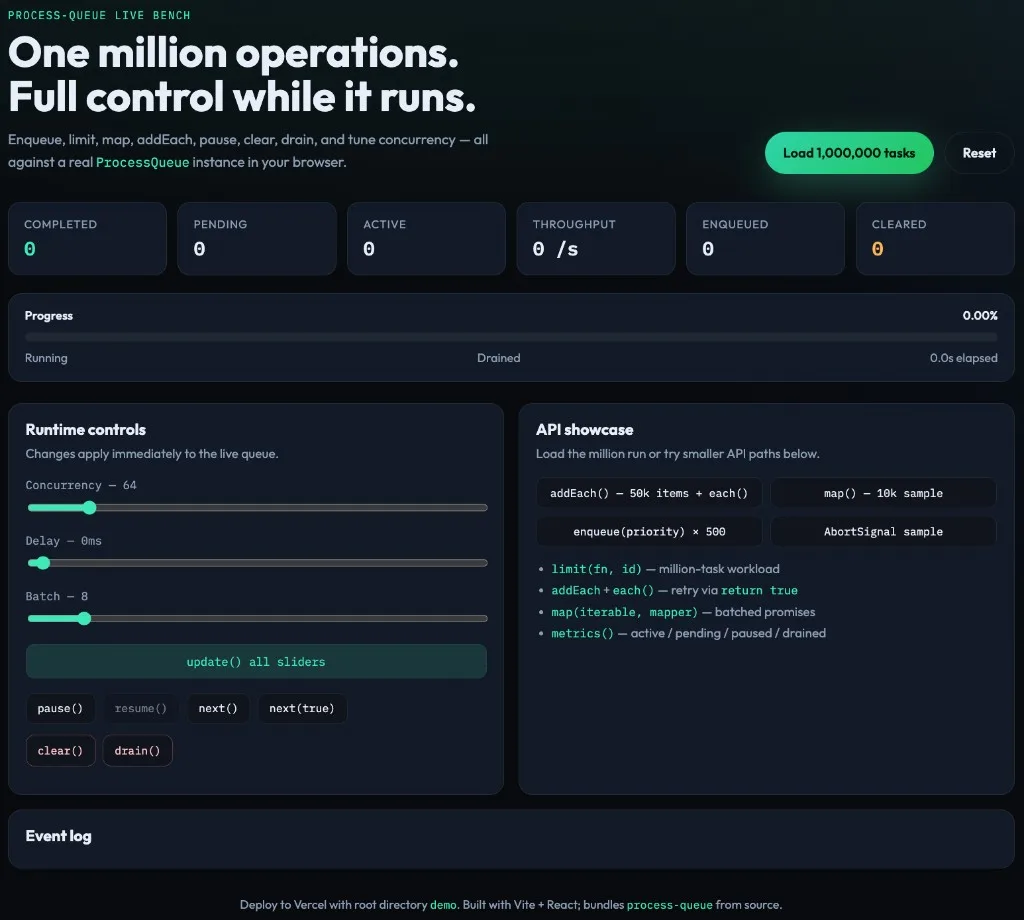
The demo runs a real ProcessQueue instance in your browser—same package the app imports from source. Load a million tasks, drag concurrency, hit pause(), watch throughput climb.
If the embed does not load, open process-queue.vercel.app in a new tab.
The headline on the page is deliberate: “One million operations. Full control while it runs.” That is the promise—bounded parallelism you can steer mid-flight, not a fire-and-forget Promise.all that eats the tab.
Why I built it
I kept reaching for two patterns in the same codebase:
- “Run at most N at a time” — API calls, file chunks, worker-style tasks.
- “Process this backlog with rules” — pause for maintenance, clear on cancel, batch dequeue, retry a failed item.
Copy-pasting p-limit plus a home-grown queue always drifted. One place updated concurrency; the other did not. One had drain(); the other used ad-hoc counters.
ProcessQueue is the unified type I wanted:
import { ProcessQueue } from "process-queue";

const queue = new ProcessQueue({ concurrency: 4, batch: 8 });

await queue.limit(async (id: number) => fetchItem(id), 42);
queue.addEach(items);
queue.pause();
queue.update({ concurrency: 64 });
queue.resume();
await queue.drain();
Strengths (what it does well)
1. Hybrid API without a second dependency
| You need… | Reach for… |
|---|---|
p-limit-style tasks | limit(), enqueue(), map() |
| QueueManager-style items | add(), addEach(), each(), complete() |
| Backpressure + lifecycle | pause(), resume(), next(), clear(), drain() |
| Observability | metrics(), activeCount, pendingCount |
2. Runtime control
Concurrency is not only a constructor argument—you can update({ concurrency, delay, batch }) or assign queue.concurrency = 64 while work is in flight. The live bench wires every slider to update() so you feel the scheduler respond.
delay supports throttling between dispatch cycles; delay: -1 switches to manual stepping via next()—useful when you want explicit control (and documented in the README).
3. Practical extras
- Priority enqueue —
enqueue(task, { priority: true })pushes to the front. - AbortSignal — cancelled tasks reject without wedging the queue.
maxQueueSize— optional cap withQueueCapacityError.- Retry hook —
each()handler canreturn trueto re-queue an item (demo uses this for a one-shot retry path). rejectOnClear— pending promises reject onclear()when you need hard cancellation semantics.
4. Implementation choices that matter at scale
- Pending work sits in a deque (
push/shift/pushFront)—not a shifting array. - Dispatch uses
queueMicrotaskwhendelay <= 0so bursts do not synchronously starve the UI thread. - The million-task demo does not enqueue one million separate UI updates blindly—it batches enqueues (
ENQUEUE_CHUNK = 5000) and groups 20 logical ops per task so the bench stresses the scheduler without pretending every app should spawn 1e6 promises naively.
5. Discipline around quality
- Vitest unit, integration, reliability, and performance smoke tests.
- ESLint + strict TypeScript;
prepublishOnlyruns lint, typecheck, test, build. - Zero production dependencies in the package itself.
Weaknesses (honest limits)
No library is free lunch. These are the tradeoffs I would tell a teammate before adopting:
1. It is not a distributed queue
Everything is in-process (Node or browser). No Redis, no persistence, no cross-tab leader election. For background jobs across machines, you still want BullMQ, SQS, or similar.
2. map() is not a streaming map
map(iterable, mapper) builds an array of limit() promises and Promise.alls them. Fine for thousands of items; for millions, you will allocate millions of promises unless you chunk at the call site—exactly what the bench teaches.
3. addEach is convenient, not magical
Each item becomes a queued entry. Dumping a huge array without chunking can stress memory. The API is honest; the caller owns batching strategy.
4. indexOf is linear
It walks pending entries. Fine for moderate queues; not a database index.
5. Mental model overlap
If you only need a tiny p-limit clone, this package is more API surface than you need. The value appears when you also want pause/clear/drain/metrics—or when you are tired of two abstractions diverging.
6. Breaking by design
The README states migration from legacy QueueManager / p-limit setups is intentionally breaking. You adopt the hybrid model, not a drop-in alias.
7. Young project
The repo is new; battle-testing happens in your app and in the bench—not a decade of npm downloads. Treat v1 as “solid tests + clear API,” not “industry default.”
What the bench is proving
The Vite + React UI is a teaching instrument:
- Load 1,000,000 tasks — chunked enqueue, bundled ops per task, progress and throughput meters.
- Runtime sliders — concurrency (default 256 in the demo), delay, batch.
- Control panel —
pause(),resume(),next(),clear(),drain()wired to buttons. - Samples —
addEach,map, priority burst,AbortSignal—each logs to the event panel.
Target run time is tuned around ~45 seconds for the full million on a decent machine—not a benchmark certificate, but a regression spectacle: if dispatch regresses, you see it in the progress bar.
When to reach for it
Good fit:
- Browser or Node apps that need bounded concurrency plus pause/cancel/drain.
- Migrating off “
p-limit+ hand-rolled queue state.” - Workers, crawlers, importers, batch processors where operators tune throughput live.
Poor fit:
- Distributed job systems.
- Durable queues that survive process restarts.
- One-liner “just limit to 5” with no lifecycle—use the smallest tool.
Get the code
git clone https://github.com/maggiben/ProcessQueue.git
cd ProcessQueue
npm install
npm test
npm run build
cd demo && npm install && npm run dev
Package name on npm: process-queue (see README for npm install process-queue when published).
Related experiments on this blog: Rings pushes the GPU; Shredder pushes tick workers; process-queue pushes the humble event loop—and asks whether you can still steer it at task one million.
Live bench: process-queue.vercel.app. Source: github.com/maggiben/ProcessQueue.